
Project Hail Mary
Updated: May 28
Released 2026. Directors: Phil Lord, Christopher Miller
THE SCI-FI GENRE OFTEN GETS HIJACKED BY IMPOSTERS. Movies with little to do with science, those cruising on some pseudo-science ideas, or those which are pure fantasies, are carelessly labelled the umbrella term, which tarnishes the definition itself. Contact and Interstellar are sci-fi. Armageddon and Transformers are not.
Project Hail Mary, I'm glad to say, is legitimate science fiction -- imaginative, logical and engrossing. I'd expect no less from Andy Weir, the author of The Martian, in which Matt Damon's stranded astronaut uses real-world science to stay alive on a hostile planet, and it's also really entertaining to watch how he does it.
Project Hail Mary is an enthralling invention in which a scientist employs his knowledge and training in lab-tested as well as speculative science (as opposed to Star Trek invention) to save the day. You have a science question? Weir has an answer. He explains how, for example, humans can travel from Earth to a destination nearly 12 light years away in just a few years; how gravity is generated in a speeding spacecraft; and what intelligent life-form is possible on a planet with 22 times the atmospheric pressure where it's perpetually dark.
But forget about all that. You don't need to be interested in those questions to get onboard the Hail Mary. The movie is grounded in hard science while being extremely engaging and a thrilling adventure.
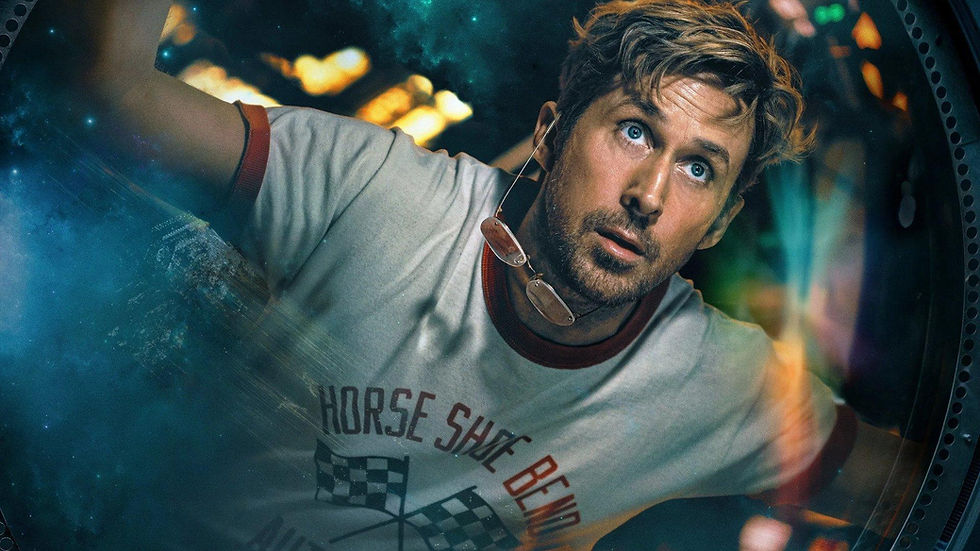
The movie begins with middle-school science teacher Ryland Grace waking up from an induced coma onboard the spacecraft Hail Mary. Fogged with amnesia, he doesn't remember much about what he's doing there, or where he's going. Two other crew members onboard have died and there's nobody else to tell him what's going on. While he certainly doesn't behave like an astronaut, Grace is knowledgeable about a lot of stuff around him instinctively. “Why do I know that?” He surprises himself.
As Grace slowly recovers from his fugue state and figures out his mission, memories return in snatches, filling the audience in on the purpose of his mission. Our Sun is dimming. Microorganism called astrophage is absorbing the Sun's energy at an alarming rate. Grace also recalls being recruited by Eva Stratt (the always impressive Sandra Huller), who heads the global taskforce and tells him that in 30 years, temperature on Earth will drop to a level that crops will fail and a quarter of the population will die from starvation. Wars will break out when countries fight for diminishing resources while the Sun continues to darken. So unless we can find a fix soon, the human race is doomed.
That's why Grace is heading towards Tau Ceti, a Sun much like ours but isn't affected by the astrophage plague spreading across our corner of the galaxy. Grace needs to find out why and send the solution back to Earth in time before it's too late. As for himself, that'll be the last thing he'll ever do because Hail Mary only has enough fuel for a one-way trip. What a brave man, so he thinks.
All this is mere background set-up for the real story, which is an improbable friendship between Grace, a human person, and Rocky, an alien shaped like a giant crab with a rock-like carapace, hence the name. Finding an intelligent alien life form is not part of Hail Mary's mission but the serendipitous contact is an accident that leads to the salvation of two planets.
When Rocky “speaks” the human ears hear music notes and the scientist devises a method to interpret vocabulary for both parties. Before long, Grace and Rocky learn they are here for the same reason: to solve the mystery of astrophage to save their own world.
Weir's book is packed dense with details, with vivid descriptions of the challenges and solutions using basic tools or sophisticated technology. The passages are never dry because he's also created an odd couple who are not only engaging but at times, very funny in their interactions. The friendship between Grace and Rocky is the emotional core and it's amazing how Weir completely draws us in to care for their predicament. If I had a small quibble, the poignancy threaded through the 500 pages is less compelling in the transition from print to screen. Some moments whiz past when you expect them to linger. Regardless, Drew Goddard has done an outstanding adaptation given the obvious constraints.
Rocky the engineer and Grace the micro-biologist collaborate on problem solving and also save each other's life in a couple of catastrophic moments. Looking out for each other is not so much a survival strategy in space but an imperative from someplace deeper. As Rocky tells Grace in his Eridian syntax “Rocky watch whole crew die. Could not fix. Grace say Grace will die. Rocky fix.” True to his word, the alien risks his own life when he breaks out of his protective atmospheric bubble to save an unconscious Grace when the spacecraft suffered a structural damage.
Rocky also prolongs his own journey home when he gives Grace enough fuel to return to Earth, thus saving Grace from a suicide mission, after they have solved the astrophage crisis. The two friends part ways, never to meet again.
The story could've ended there, but Weir devises a survival crisis to take it up another notch. A new emergency breaks out and Grace realises that Rocky will die on his spacecraft before making it home. He's faced with a dilemma. To continue on his route back to Earth and let Rocky and his species die, or turn around on limited fuel and try to find Rocky if at all possible, in turn passing his own death sentence. The self-sacrifice that Grace makes is a moment that turns a protagonist into a hero.
This last point is especially relevant to understanding Grace who, as it turns out, was actively refusing to board the Hail Mary. A self-confessed coward, he did not want to die in space to save the human race. He had to be sedated, basically kidnapped against his will, to do his job as the best qualified candidate.
For Grace to now forego the opportunity to return home as humanity's saviour and instead, sail into the dark unknown hoping to save a alien crab creature is the apex in his character arc. When Grace finds Rocky alive in a dark corridor of his endangered spacecraft, they should've asked John Williams to compose an emotional symphony.
Project Hail Mary, built on a bedrock of scientific details, is essentially about courage and friendship. The bond between Grace and Rocky, the comic buddy duo, is humorous, heartening and touching. For two friends who are unable to survive in the other's atmosphere, their mutual support is selfless.
The character of Grace is a revision of movie masculinity, Ryan Gosling not only nails the bookish scientist role with every droll delivery but he does so wearing a cardigan, not holding a gun firing at enemies. The world's saviour is not an alpha male but a bespectacled school-teacher who's a little goofy and not afraid to admit he's not the bravest. As for Rocky, this strange faceless creature is an endearing addition to the cinematic alien family and if I may borrow his rudimentary yet refreshing expression to summarise the movie in one word: “Amaze. Amaze. Amaze.”
Click image above to view trailer. New window will open.


Your opening paragraph is spot on. Transformers are vapid cash-grabs based on toys! I LOVE Project Hail Mary, and it totally lived up to the hype. I hadn't read the book, but I enjoyed The Martian, and I like this one even more. The bond between Grace and Rocky made me laugh and cry. Amazing indeed!